
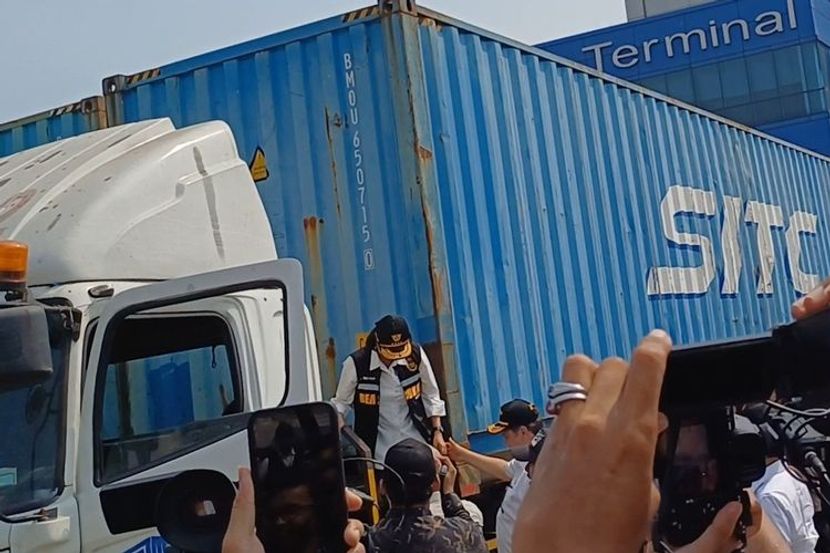
The Minister of Finance revealed the progress in handling the backlog of 26,415 containers at Tanjung Priok Port in North Jakarta and Tanjung Perak Port in Surabaya. Since the government issued new regulations to address the container congestion, entry procedures for 16,451 containers at the two ports have been completed, meaning 62.3% of the accumulated containers have finished procedures. Among these, 15,662 containers have obtained customs clearance, 73 containers have been returned, and another 716 containers are under customs supervision. She emphasized that speeding up imports by reducing some documentation requirements is aimed at overcoming disruptions in the national supply chain, therefore, despite the relaxation of import license requirements, she ensured that the Directorate General of Customs would continue to carry out its duties to prevent the entry of goods that could harm the domestic market. The government aims to solve the supply chain issues affected by containers being unable to clear customs, which of course impacts production. However, containers carrying goods pose risks, including risks to domestic industries, so they will continue to act in accordance with trade regulations.
The Customs and Excise Office provides support through various steps to address container congestion at the ports, including 24-hour daily service. In addition, support is provided by encouraging importers to submit documents, communicating with cargo owners, and providing the latest data on surveyor order verification processes. The government recently issued the 2024 Minister of Trade Regulation (Permendag) No. 8, as an amendment to the 2023 Minister of Trade Regulation No. 36 on import policies and regulations. One of the purposes of issuing this regulation is to resolve the issue of tens of thousands of containers piling up at the two ports. The regulation relaxes import restrictions on 7 categories of goods previously regulated. The government no longer requires import permits (PI) for four categories: traditional medicines and health supplements, cosmetics and household goods, bags, and valves. The government also no longer requires technical restrictions (pertek) for imports of electronic goods, footwear, clothing, and accessories.