
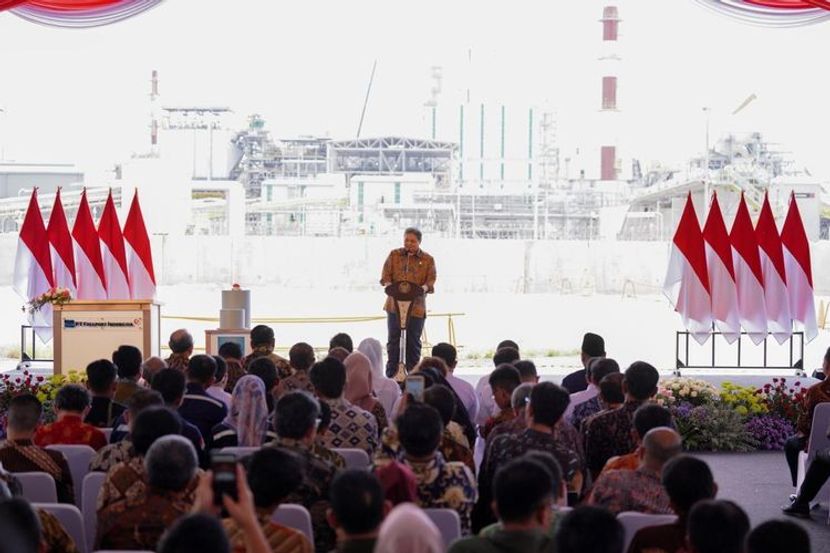
 The government has launched a downstream industry policy, expected to support the national economy in adding value and being one of the keys to maintaining economic resilience. To support this downstream policy, the role of domestic off-takers is very important, including users of copper raw materials. In addition, Indonesia's current supply of downstream copper products still relies on imported products, such as copper tubes, copper strips, copper evaporators, etc. Components needed for electric vehicle production, such as cables, inverters, and batteries, are also still using imported products. To meet these demands, the government continues to encourage downstream processing in the processing industry of Special Economic Zones (KEK). The Coordinating Minister for Economic Affairs recently stated at the inauguration ceremony of the PT Freeport Indonesia (PTFI) smelter that the completion of this factory is very timely because renewable energy is currently becoming a trend, and the renewable energy trend requires critical minerals, one of which is copper. The PTFI smelter is the world's largest single-line copper refinery, with an annual refining capacity of up to 1.7 million tons of copper concentrate. The project covers an area of 100 hectares, located in the Java Integrated Industrial and Port Estate (JIIPE) KEK in Gresik, East Java, with a cumulative investment of IDR 58 trillion, equivalent to approximately USD 3.7 billion.
This investment will not only bring benefits to domestic enterprises but also create a multiplier effect for the people of Gresik Regency. Combined with the smelter operated by PT Smelting, the two companies will refine 3 million tons of copper concentrate annually, producing approximately 600,000 tons of cathode copper, 50 tons of gold, and 200 tons of silver per year. With the smelter in operation, all copper concentrate produced by PTFI can be processed and refined domestically, including anode sludge from PT Smelting. The Coordinating Minister stated that the integration of mines is aimed at final products. Through this integration, the production of 50 tons of gold requires the payment of royalties, because it is an integration from mine to downstream, so royalties for silver also need to be paid. Therefore, the government certainly receives substantial revenue. He hopes that the presence of PTFI in the Gresik KEK can become an attraction to form an ecosystem supporting downstream industries, especially electric vehicles. As of March 2024, investment in the Gresik KEK reached IDR 75.2 trillion, absorbing more than 35,000 workers. In the future, Indonesia will be able to increase exports. If Indonesia's exports are strong, the rupiah can remain stable. For example, exports of nickel and palm oil amount to USD 55 billion, while oil imports are USD 40 billion, so there is actually a natural hedge. In addition to attending the inauguration ceremony of the PTFI smelter, the Coordinating Minister and his team also inspected the PTFI smelter area, visiting the dock area, anode casting, and the central control building. During the press conference, he also conveyed to media personnel the role of PTFI smelter operations in maintaining national economic resilience.
The government has launched a downstream industry policy, expected to support the national economy in adding value and being one of the keys to maintaining economic resilience. To support this downstream policy, the role of domestic off-takers is very important, including users of copper raw materials. In addition, Indonesia's current supply of downstream copper products still relies on imported products, such as copper tubes, copper strips, copper evaporators, etc. Components needed for electric vehicle production, such as cables, inverters, and batteries, are also still using imported products. To meet these demands, the government continues to encourage downstream processing in the processing industry of Special Economic Zones (KEK). The Coordinating Minister for Economic Affairs recently stated at the inauguration ceremony of the PT Freeport Indonesia (PTFI) smelter that the completion of this factory is very timely because renewable energy is currently becoming a trend, and the renewable energy trend requires critical minerals, one of which is copper. The PTFI smelter is the world's largest single-line copper refinery, with an annual refining capacity of up to 1.7 million tons of copper concentrate. The project covers an area of 100 hectares, located in the Java Integrated Industrial and Port Estate (JIIPE) KEK in Gresik, East Java, with a cumulative investment of IDR 58 trillion, equivalent to approximately USD 3.7 billion.
This investment will not only bring benefits to domestic enterprises but also create a multiplier effect for the people of Gresik Regency. Combined with the smelter operated by PT Smelting, the two companies will refine 3 million tons of copper concentrate annually, producing approximately 600,000 tons of cathode copper, 50 tons of gold, and 200 tons of silver per year. With the smelter in operation, all copper concentrate produced by PTFI can be processed and refined domestically, including anode sludge from PT Smelting. The Coordinating Minister stated that the integration of mines is aimed at final products. Through this integration, the production of 50 tons of gold requires the payment of royalties, because it is an integration from mine to downstream, so royalties for silver also need to be paid. Therefore, the government certainly receives substantial revenue. He hopes that the presence of PTFI in the Gresik KEK can become an attraction to form an ecosystem supporting downstream industries, especially electric vehicles. As of March 2024, investment in the Gresik KEK reached IDR 75.2 trillion, absorbing more than 35,000 workers. In the future, Indonesia will be able to increase exports. If Indonesia's exports are strong, the rupiah can remain stable. For example, exports of nickel and palm oil amount to USD 55 billion, while oil imports are USD 40 billion, so there is actually a natural hedge. In addition to attending the inauguration ceremony of the PTFI smelter, the Coordinating Minister and his team also inspected the PTFI smelter area, visiting the dock area, anode casting, and the central control building. During the press conference, he also conveyed to media personnel the role of PTFI smelter operations in maintaining national economic resilience.
The government has launched a downstream industry policy, expected to support the national economy in adding value and being one of the keys to maintaining economic resilience. To support this downstream policy, the role of domestic off-takers is very important, including users of copper raw materials. In addition, Indonesia's current supply of downstream copper products still relies on imported products, such as copper tubes, copper strips, copper evaporators, etc. Components needed for electric vehicle production, such as cables, inverters, and batteries, are also still using imported products. To meet these demands, the government continues to encourage downstream processing in the processing industry of Special Economic Zones (KEK). The Coordinating Minister for Economic Affairs recently stated at the inauguration ceremony of the PT Freeport Indonesia (PTFI) smelter that the completion of this factory is very timely because renewable energy is currently becoming a trend, and the renewable energy trend requires critical minerals, one of which is copper. The PTFI smelter is the world's largest single-line copper refinery, with an annual refining capacity of up to 1.7 million tons of copper concentrate. The project covers an area of 100 hectares, located in the Java Integrated Industrial and Port Estate (JIIPE) KEK in Gresik, East Java, with a cumulative investment of IDR 58 trillion, equivalent to approximately USD 3.7 billion.
This investment will not only bring benefits to domestic enterprises but also create a multiplier effect for the people of Gresik Regency. Combined with the smelter operated by PT Smelting, the two companies will refine 3 million tons of copper concentrate annually, producing approximately 600,000 tons of cathode copper, 50 tons of gold, and 200 tons of silver per year. With the smelter in operation, all copper concentrate produced by PTFI can be processed and refined domestically, including anode sludge from PT Smelting. The Coordinating Minister stated that the integration of mines is aimed at final products. Through this integration, the production of 50 tons of gold requires the payment of royalties, because it is an integration from mine to downstream, so royalties for silver also need to be paid. Therefore, the government certainly receives substantial revenue. He hopes that the presence of PTFI in the Gresik KEK can become an attraction to form an ecosystem supporting downstream industries, especially electric vehicles. As of March 2024, investment in the Gresik KEK reached IDR 75.2 trillion, absorbing more than 35,000 workers. In the future, Indonesia will be able to increase exports. If Indonesia's exports are strong, the rupiah can remain stable. For example, exports of nickel and palm oil amount to USD 55 billion, while oil imports are USD 40 billion, so there is actually a natural hedge. In addition to attending the inauguration ceremony of the PTFI smelter, the Coordinating Minister and his team also inspected the PTFI smelter area, visiting the dock area, anode casting, and the central control building. During the press conference, he also conveyed to media personnel the role of PTFI smelter operations in maintaining national economic resilience.
The government has launched a downstream industry policy, expected to support the national economy in adding value and being one of the keys to maintaining economic resilience. To support this downstream policy, the role of domestic off-takers is very important, including users of copper raw materials. In addition, Indonesia's current supply of downstream copper products still relies on imported products, such as copper tubes, copper strips, copper evaporators, etc. Components needed for electric vehicle production, such as cables, inverters, and batteries, are also still using imported products. To meet these demands, the government continues to encourage downstream processing in the processing industry of Special Economic Zones (KEK). The Coordinating Minister for Economic Affairs recently stated at the inauguration ceremony of the PT Freeport Indonesia (PTFI) smelter that the completion of this factory is very timely because renewable energy is currently becoming a trend, and the renewable energy trend requires critical minerals, one of which is copper. The PTFI smelter is the world's largest single-line copper refinery, with an annual refining capacity of up to 1.7 million tons of copper concentrate. The project covers an area of 100 hectares, located in the Java Integrated Industrial and Port Estate (JIIPE) KEK in Gresik, East Java, with a cumulative investment of IDR 58 trillion, equivalent to approximately USD 3.7 billion.
This investment will not only bring benefits to domestic enterprises but also create a multiplier effect for the people of Gresik Regency. Combined with the smelter operated by PT Smelting, the two companies will refine 3 million tons of copper concentrate annually, producing approximately 600,000 tons of cathode copper, 50 tons of gold, and 200 tons of silver per year. With the smelter in operation, all copper concentrate produced by PTFI can be processed and refined domestically, including anode sludge from PT Smelting. The Coordinating Minister stated that the integration of mines is aimed at final products. Through this integration, the production of 50 tons of gold requires the payment of royalties, because it is an integration from mine to downstream, so royalties for silver also need to be paid. Therefore, the government certainly receives substantial revenue. He hopes that the presence of PTFI in the Gresik KEK can become an attraction to form an ecosystem supporting downstream industries, especially electric vehicles. As of March 2024, investment in the Gresik KEK reached IDR 75.2 trillion, absorbing more than 35,000 workers. In the future, Indonesia will be able to increase exports. If Indonesia's exports are strong, the rupiah can remain stable. For example, exports of nickel and palm oil amount to USD 55 billion, while oil imports are USD 40 billion, so there is actually a natural hedge. In addition to attending the inauguration ceremony of the PTFI smelter, the Coordinating Minister and his team also inspected the PTFI smelter area, visiting the dock area, anode casting, and the central control building. During the press conference, he also conveyed to media personnel the role of PTFI smelter operations in maintaining national economic resilience.