

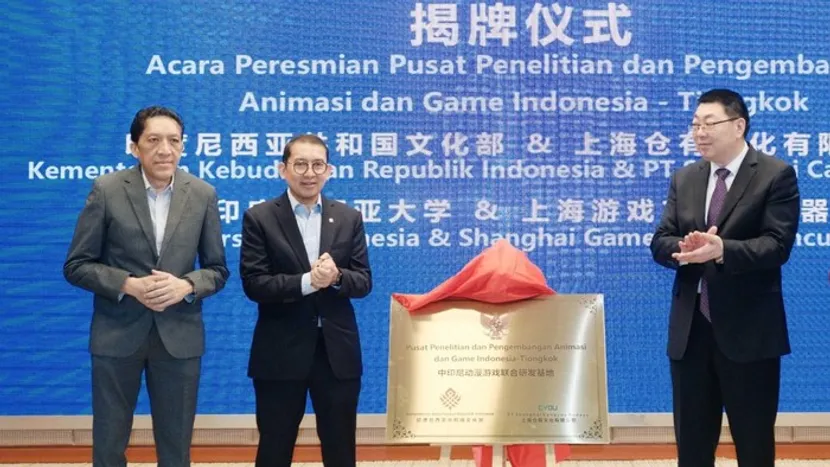
 Indonesia's Minister of Culture recently attended the inauguration ceremony of the China-Indonesia Animation and Electronic Game Joint R&D Center in Shanghai, marking a new phase in bilateral digital cultural cooperation, focusing on animation, game development, cultural intellectual property, talent cultivation, scientific research innovation, and coordinated development of the cultural and creative industries. The establishment of this center upgrades bilateral cooperation from traditional cultural exchanges to a co-creation model, shifting from exchange of works to joint creation, joint R&D and production, collectively incubating original IPs, technological achievements, and high-quality cultural and creative works for the global market. He stated that over the 76 years of diplomatic relations, China-Indonesia cooperation has long relied on history, trade, diplomacy, and people-to-people exchanges, and in the future, it will be led by a new generation of creative talents such as animators, game developers, designers, and digital entrepreneurs, broadening the boundaries of cooperation.
China boasts world-leading digital creative industry ecosystems, mature production systems, and commercialization capabilities, while Indonesia has diverse and profound cultural resources that can provide rich storytelling material and cultural core for films, games, and world-building. The minister emphasized that Indonesia needs to dig deep into its local cultural value, avoid cultural elements becoming mere visual decorations, and transform them into competitive original narratives and distinctive IP assets. The global cultural and creative industry is growing strongly, with the global game market expected to exceed 275 billion USD by 2026. Indonesia's digital game consumption potential is enormous, with mobile game downloads reaching 870 million in Q1 2026, ranking first in Southeast Asia, approximately 192 million game users, accounting for nearly half of Southeast Asia, and local market size reaching 2.5 billion USD. However, the Indonesian market has long been dominated by overseas products, with weak local original production capacity, urgently needing to transform from a consumer market to a digital creative production, R&D, and IP-exporting country.
To this end, Indonesia's Ministry of Culture is accelerating the construction of digital culture, building a cultural data center, improving cultural digital standards, advancing the development of innovative ecosystems such as AI, virtual-real technology, animation, and games, completing digital archiving of over 4,300 cultural assets, and leveraging multiple cultural and creative support programs to nurture local original cultural games and animation works. This cooperation also recognized 11 Chinese partner institutions, covering game industry incubation, network technology, cultural tourism education and research, film and television media, etc., building a diversified collaborative network of industry, academia, and research. The minister proposed six development visions for the joint center: jointly developing bilateral cultural IPs, cultivating professional cultural and creative talents, promoting government-enterprise-academia-research collaboration, compliantly building a digital cultural database, expanding Asian and global markets, and strengthening cultural diplomacy through digital works.
Against the backdrop of deep integration of technology, culture, and economy, Indonesia is committed to revitalizing traditional cultural heritage, comprehensively deploying in the digital arena, and integrating local culture into the global industrial chain. This joint center will become an important bridge connecting China's technological advantages with Indonesia's cultural creativity, linking young talents from both countries with the international market, helping to deepen bilateral cultural friendly relations and achieve long-term mutually beneficial development of the cultural and creative industries.
Indonesia's Minister of Culture recently attended the inauguration ceremony of the China-Indonesia Animation and Electronic Game Joint R&D Center in Shanghai, marking a new phase in bilateral digital cultural cooperation, focusing on animation, game development, cultural intellectual property, talent cultivation, scientific research innovation, and coordinated development of the cultural and creative industries. The establishment of this center upgrades bilateral cooperation from traditional cultural exchanges to a co-creation model, shifting from exchange of works to joint creation, joint R&D and production, collectively incubating original IPs, technological achievements, and high-quality cultural and creative works for the global market. He stated that over the 76 years of diplomatic relations, China-Indonesia cooperation has long relied on history, trade, diplomacy, and people-to-people exchanges, and in the future, it will be led by a new generation of creative talents such as animators, game developers, designers, and digital entrepreneurs, broadening the boundaries of cooperation.
China boasts world-leading digital creative industry ecosystems, mature production systems, and commercialization capabilities, while Indonesia has diverse and profound cultural resources that can provide rich storytelling material and cultural core for films, games, and world-building. The minister emphasized that Indonesia needs to dig deep into its local cultural value, avoid cultural elements becoming mere visual decorations, and transform them into competitive original narratives and distinctive IP assets. The global cultural and creative industry is growing strongly, with the global game market expected to exceed 275 billion USD by 2026. Indonesia's digital game consumption potential is enormous, with mobile game downloads reaching 870 million in Q1 2026, ranking first in Southeast Asia, approximately 192 million game users, accounting for nearly half of Southeast Asia, and local market size reaching 2.5 billion USD. However, the Indonesian market has long been dominated by overseas products, with weak local original production capacity, urgently needing to transform from a consumer market to a digital creative production, R&D, and IP-exporting country.
To this end, Indonesia's Ministry of Culture is accelerating the construction of digital culture, building a cultural data center, improving cultural digital standards, advancing the development of innovative ecosystems such as AI, virtual-real technology, animation, and games, completing digital archiving of over 4,300 cultural assets, and leveraging multiple cultural and creative support programs to nurture local original cultural games and animation works. This cooperation also recognized 11 Chinese partner institutions, covering game industry incubation, network technology, cultural tourism education and research, film and television media, etc., building a diversified collaborative network of industry, academia, and research. The minister proposed six development visions for the joint center: jointly developing bilateral cultural IPs, cultivating professional cultural and creative talents, promoting government-enterprise-academia-research collaboration, compliantly building a digital cultural database, expanding Asian and global markets, and strengthening cultural diplomacy through digital works.
Against the backdrop of deep integration of technology, culture, and economy, Indonesia is committed to revitalizing traditional cultural heritage, comprehensively deploying in the digital arena, and integrating local culture into the global industrial chain. This joint center will become an important bridge connecting China's technological advantages with Indonesia's cultural creativity, linking young talents from both countries with the international market, helping to deepen bilateral cultural friendly relations and achieve long-term mutually beneficial development of the cultural and creative industries.
Indonesia's Minister of Culture recently attended the inauguration ceremony of the China-Indonesia Animation and Electronic Game Joint R&D Center in Shanghai, marking a new phase in bilateral digital cultural cooperation, focusing on animation, game development, cultural intellectual property, talent cultivation, scientific research innovation, and coordinated development of the cultural and creative industries. The establishment of this center upgrades bilateral cooperation from traditional cultural exchanges to a co-creation model, shifting from exchange of works to joint creation, joint R&D and production, collectively incubating original IPs, technological achievements, and high-quality cultural and creative works for the global market. He stated that over the 76 years of diplomatic relations, China-Indonesia cooperation has long relied on history, trade, diplomacy, and people-to-people exchanges, and in the future, it will be led by a new generation of creative talents such as animators, game developers, designers, and digital entrepreneurs, broadening the boundaries of cooperation.
China boasts world-leading digital creative industry ecosystems, mature production systems, and commercialization capabilities, while Indonesia has diverse and profound cultural resources that can provide rich storytelling material and cultural core for films, games, and world-building. The minister emphasized that Indonesia needs to dig deep into its local cultural value, avoid cultural elements becoming mere visual decorations, and transform them into competitive original narratives and distinctive IP assets. The global cultural and creative industry is growing strongly, with the global game market expected to exceed 275 billion USD by 2026. Indonesia's digital game consumption potential is enormous, with mobile game downloads reaching 870 million in Q1 2026, ranking first in Southeast Asia, approximately 192 million game users, accounting for nearly half of Southeast Asia, and local market size reaching 2.5 billion USD. However, the Indonesian market has long been dominated by overseas products, with weak local original production capacity, urgently needing to transform from a consumer market to a digital creative production, R&D, and IP-exporting country.
To this end, Indonesia's Ministry of Culture is accelerating the construction of digital culture, building a cultural data center, improving cultural digital standards, advancing the development of innovative ecosystems such as AI, virtual-real technology, animation, and games, completing digital archiving of over 4,300 cultural assets, and leveraging multiple cultural and creative support programs to nurture local original cultural games and animation works. This cooperation also recognized 11 Chinese partner institutions, covering game industry incubation, network technology, cultural tourism education and research, film and television media, etc., building a diversified collaborative network of industry, academia, and research. The minister proposed six development visions for the joint center: jointly developing bilateral cultural IPs, cultivating professional cultural and creative talents, promoting government-enterprise-academia-research collaboration, compliantly building a digital cultural database, expanding Asian and global markets, and strengthening cultural diplomacy through digital works.
Against the backdrop of deep integration of technology, culture, and economy, Indonesia is committed to revitalizing traditional cultural heritage, comprehensively deploying in the digital arena, and integrating local culture into the global industrial chain. This joint center will become an important bridge connecting China's technological advantages with Indonesia's cultural creativity, linking young talents from both countries with the international market, helping to deepen bilateral cultural friendly relations and achieve long-term mutually beneficial development of the cultural and creative industries.
Indonesia's Minister of Culture recently attended the inauguration ceremony of the China-Indonesia Animation and Electronic Game Joint R&D Center in Shanghai, marking a new phase in bilateral digital cultural cooperation, focusing on animation, game development, cultural intellectual property, talent cultivation, scientific research innovation, and coordinated development of the cultural and creative industries. The establishment of this center upgrades bilateral cooperation from traditional cultural exchanges to a co-creation model, shifting from exchange of works to joint creation, joint R&D and production, collectively incubating original IPs, technological achievements, and high-quality cultural and creative works for the global market. He stated that over the 76 years of diplomatic relations, China-Indonesia cooperation has long relied on history, trade, diplomacy, and people-to-people exchanges, and in the future, it will be led by a new generation of creative talents such as animators, game developers, designers, and digital entrepreneurs, broadening the boundaries of cooperation.
China boasts world-leading digital creative industry ecosystems, mature production systems, and commercialization capabilities, while Indonesia has diverse and profound cultural resources that can provide rich storytelling material and cultural core for films, games, and world-building. The minister emphasized that Indonesia needs to dig deep into its local cultural value, avoid cultural elements becoming mere visual decorations, and transform them into competitive original narratives and distinctive IP assets. The global cultural and creative industry is growing strongly, with the global game market expected to exceed 275 billion USD by 2026. Indonesia's digital game consumption potential is enormous, with mobile game downloads reaching 870 million in Q1 2026, ranking first in Southeast Asia, approximately 192 million game users, accounting for nearly half of Southeast Asia, and local market size reaching 2.5 billion USD. However, the Indonesian market has long been dominated by overseas products, with weak local original production capacity, urgently needing to transform from a consumer market to a digital creative production, R&D, and IP-exporting country.
To this end, Indonesia's Ministry of Culture is accelerating the construction of digital culture, building a cultural data center, improving cultural digital standards, advancing the development of innovative ecosystems such as AI, virtual-real technology, animation, and games, completing digital archiving of over 4,300 cultural assets, and leveraging multiple cultural and creative support programs to nurture local original cultural games and animation works. This cooperation also recognized 11 Chinese partner institutions, covering game industry incubation, network technology, cultural tourism education and research, film and television media, etc., building a diversified collaborative network of industry, academia, and research. The minister proposed six development visions for the joint center: jointly developing bilateral cultural IPs, cultivating professional cultural and creative talents, promoting government-enterprise-academia-research collaboration, compliantly building a digital cultural database, expanding Asian and global markets, and strengthening cultural diplomacy through digital works.
Against the backdrop of deep integration of technology, culture, and economy, Indonesia is committed to revitalizing traditional cultural heritage, comprehensively deploying in the digital arena, and integrating local culture into the global industrial chain. This joint center will become an important bridge connecting China's technological advantages with Indonesia's cultural creativity, linking young talents from both countries with the international market, helping to deepen bilateral cultural friendly relations and achieve long-term mutually beneficial development of the cultural and creative industries.