
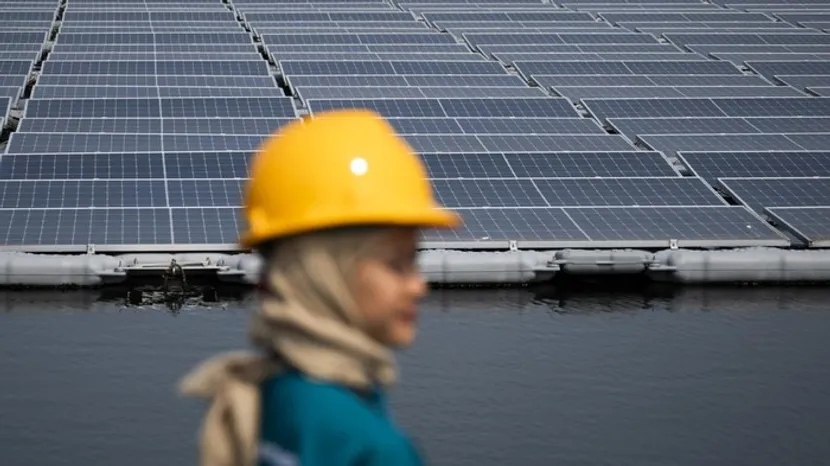
 The Ministry of Energy and Mineral Resources is jointly conducting a reservoir survey and planning with the Ministry of Public Works, aiming to vigorously develop floating solar photovoltaic power plants (PLTS apung) on reservoir surfaces to accelerate the achievement of the national strategic target of 100 GW total solar installed capacity. The Director General of New Energy, Renewable Energy, and Energy Conservation at the Ministry of Energy and Mineral Resources stated at the recent launch ceremony of Indonesia's 1 GW rooftop solar program that, according to preliminary calculations, if 20% of the water surface area of reservoirs under construction and existing reservoirs managed by the Ministry of Public Works were developed for floating solar, it could add more than 15 GW of solar photovoltaic capacity, becoming an important support for Indonesia to achieve its solar target.
The core purpose of this reservoir solar resource survey is to fully sprint towards the ambitious target of reaching 100 GW of national solar installed capacity by 2029. She emphasized that this goal is not only to increase the scale of clean energy installations, but also to drive domestic photovoltaic industry demand through large-scale project construction, promoting the growth of the local industrial chain. Data shows that as of now, Indonesia's cumulative installed solar photovoltaic capacity is approximately 1.5 GW, of which rooftop solar contributes 895 MW, still in an early stage. She admitted that Indonesia is still striving to achieve a larger scale of solar installations, and the current policy direction is not only to accelerate the construction of ground-mounted centralized solar and rooftop distributed solar, but also to focus on promoting the large-scale deployment of floating solar. Floating solar will become an important source of new capacity.
Indonesia has abundant water resources such as reservoirs and lakes. Developing floating solar can avoid occupying land resources, while also reducing water evaporation and improving power generation efficiency. Developing solar power plants on reservoirs also facilitates the integrated utilization of water infrastructure and energy projects. This cross-departmental cooperation planning marks Indonesia's energy transition entering a phase of diversified deployment. By advancing "three paths simultaneously" — ground, rooftop, and water — Indonesia can rapidly expand its solar installation scale, while driving employment and industrial development, further increasing the share of renewable energy in the national energy mix.
The Ministry of Energy and Mineral Resources is jointly conducting a reservoir survey and planning with the Ministry of Public Works, aiming to vigorously develop floating solar photovoltaic power plants (PLTS apung) on reservoir surfaces to accelerate the achievement of the national strategic target of 100 GW total solar installed capacity. The Director General of New Energy, Renewable Energy, and Energy Conservation at the Ministry of Energy and Mineral Resources stated at the recent launch ceremony of Indonesia's 1 GW rooftop solar program that, according to preliminary calculations, if 20% of the water surface area of reservoirs under construction and existing reservoirs managed by the Ministry of Public Works were developed for floating solar, it could add more than 15 GW of solar photovoltaic capacity, becoming an important support for Indonesia to achieve its solar target.
The core purpose of this reservoir solar resource survey is to fully sprint towards the ambitious target of reaching 100 GW of national solar installed capacity by 2029. She emphasized that this goal is not only to increase the scale of clean energy installations, but also to drive domestic photovoltaic industry demand through large-scale project construction, promoting the growth of the local industrial chain. Data shows that as of now, Indonesia's cumulative installed solar photovoltaic capacity is approximately 1.5 GW, of which rooftop solar contributes 895 MW, still in an early stage. She admitted that Indonesia is still striving to achieve a larger scale of solar installations, and the current policy direction is not only to accelerate the construction of ground-mounted centralized solar and rooftop distributed solar, but also to focus on promoting the large-scale deployment of floating solar. Floating solar will become an important source of new capacity.
Indonesia has abundant water resources such as reservoirs and lakes. Developing floating solar can avoid occupying land resources, while also reducing water evaporation and improving power generation efficiency. Developing solar power plants on reservoirs also facilitates the integrated utilization of water infrastructure and energy projects. This cross-departmental cooperation planning marks Indonesia's energy transition entering a phase of diversified deployment. By advancing "three paths simultaneously" — ground, rooftop, and water — Indonesia can rapidly expand its solar installation scale, while driving employment and industrial development, further increasing the share of renewable energy in the national energy mix.
The Ministry of Energy and Mineral Resources is jointly conducting a reservoir survey and planning with the Ministry of Public Works, aiming to vigorously develop floating solar photovoltaic power plants (PLTS apung) on reservoir surfaces to accelerate the achievement of the national strategic target of 100 GW total solar installed capacity. The Director General of New Energy, Renewable Energy, and Energy Conservation at the Ministry of Energy and Mineral Resources stated at the recent launch ceremony of Indonesia's 1 GW rooftop solar program that, according to preliminary calculations, if 20% of the water surface area of reservoirs under construction and existing reservoirs managed by the Ministry of Public Works were developed for floating solar, it could add more than 15 GW of solar photovoltaic capacity, becoming an important support for Indonesia to achieve its solar target.
The core purpose of this reservoir solar resource survey is to fully sprint towards the ambitious target of reaching 100 GW of national solar installed capacity by 2029. She emphasized that this goal is not only to increase the scale of clean energy installations, but also to drive domestic photovoltaic industry demand through large-scale project construction, promoting the growth of the local industrial chain. Data shows that as of now, Indonesia's cumulative installed solar photovoltaic capacity is approximately 1.5 GW, of which rooftop solar contributes 895 MW, still in an early stage. She admitted that Indonesia is still striving to achieve a larger scale of solar installations, and the current policy direction is not only to accelerate the construction of ground-mounted centralized solar and rooftop distributed solar, but also to focus on promoting the large-scale deployment of floating solar. Floating solar will become an important source of new capacity.
Indonesia has abundant water resources such as reservoirs and lakes. Developing floating solar can avoid occupying land resources, while also reducing water evaporation and improving power generation efficiency. Developing solar power plants on reservoirs also facilitates the integrated utilization of water infrastructure and energy projects. This cross-departmental cooperation planning marks Indonesia's energy transition entering a phase of diversified deployment. By advancing "three paths simultaneously" — ground, rooftop, and water — Indonesia can rapidly expand its solar installation scale, while driving employment and industrial development, further increasing the share of renewable energy in the national energy mix.
The Ministry of Energy and Mineral Resources is jointly conducting a reservoir survey and planning with the Ministry of Public Works, aiming to vigorously develop floating solar photovoltaic power plants (PLTS apung) on reservoir surfaces to accelerate the achievement of the national strategic target of 100 GW total solar installed capacity. The Director General of New Energy, Renewable Energy, and Energy Conservation at the Ministry of Energy and Mineral Resources stated at the recent launch ceremony of Indonesia's 1 GW rooftop solar program that, according to preliminary calculations, if 20% of the water surface area of reservoirs under construction and existing reservoirs managed by the Ministry of Public Works were developed for floating solar, it could add more than 15 GW of solar photovoltaic capacity, becoming an important support for Indonesia to achieve its solar target.
The core purpose of this reservoir solar resource survey is to fully sprint towards the ambitious target of reaching 100 GW of national solar installed capacity by 2029. She emphasized that this goal is not only to increase the scale of clean energy installations, but also to drive domestic photovoltaic industry demand through large-scale project construction, promoting the growth of the local industrial chain. Data shows that as of now, Indonesia's cumulative installed solar photovoltaic capacity is approximately 1.5 GW, of which rooftop solar contributes 895 MW, still in an early stage. She admitted that Indonesia is still striving to achieve a larger scale of solar installations, and the current policy direction is not only to accelerate the construction of ground-mounted centralized solar and rooftop distributed solar, but also to focus on promoting the large-scale deployment of floating solar. Floating solar will become an important source of new capacity.
Indonesia has abundant water resources such as reservoirs and lakes. Developing floating solar can avoid occupying land resources, while also reducing water evaporation and improving power generation efficiency. Developing solar power plants on reservoirs also facilitates the integrated utilization of water infrastructure and energy projects. This cross-departmental cooperation planning marks Indonesia's energy transition entering a phase of diversified deployment. By advancing "three paths simultaneously" — ground, rooftop, and water — Indonesia can rapidly expand its solar installation scale, while driving employment and industrial development, further increasing the share of renewable energy in the national energy mix.