

 The Minister of Manpower has officially signed and enacted Regulation No. 7 of 2026, imposing strict restrictions on the use of outsourcing by companies, explicitly allowing outsourcing only in six specific industry sectors. This regulation follows the 2023 ruling of the Indonesian Constitutional Court, aiming to improve legal certainty, strengthen labor rights protection, while also considering business sustainability. It was formally implemented on the eve of International Labor Day 2026. The new regulation defines six work areas where outsourcing is permitted: cleaning services, catering and logistics, security services, driver and employee commuter transport services, business operational support services, and supporting roles in the mining, oil, gas, and power industries. Beyond these, all other core business positions are prohibited from using outsourcing models, preventing companies from arbitrarily outsourcing primary jobs to avoid formal employment responsibilities.
The regulation also standardizes employment procedures, requiring client companies and outsourcing service providers to sign written agreements. Contracts must at least specify the type of outsourced work, cooperation period, work location, number of workers, labor protection details, and rights and obligations of both parties, forming a standardized contractual framework. Outsourcing companies must fully guarantee all statutory rights of workers, covering basic wages, overtime pay, working hours and leave, annual leave, occupational safety and health, health insurance and social security, religious holiday allowances, and severance compensation, without arbitrarily reducing benefits or lowering employment standards. The new regulation also establishes a penalty mechanism, imposing corresponding sanctions on client companies and outsourcing service providers for violations, urging all parties to operate in compliance.
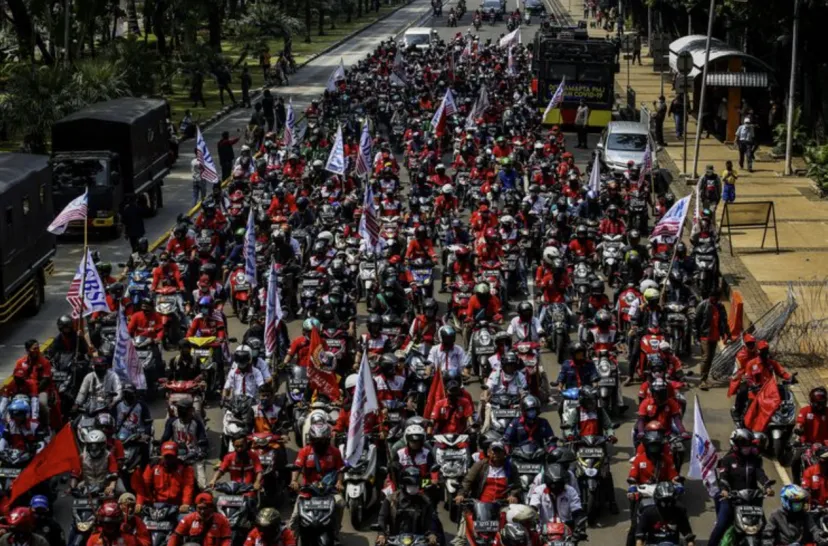
According to the Indonesian Labor Confederation, the previous Job Creation Law allowed unrestricted outsourcing across all industries without time limits, leading to widespread irregular employment, wage suppression, and infringement of labor rights. The new regulation returns to the framework of Law No. 13 of 2003, not only limiting outsourced job types but also will later introduce time limits on outsourced employment to prevent indefinite outsourcing. The Prabowo government has issued this ministerial regulation as an interim measure to fill regulatory gaps, and will later incorporate outsourcing rule revisions into the new Labor Law legislative process to fully improve the system design at the legal level. The government calls on all parties to strictly comply with the new regulations, standardize outsourcing practices, protect workers' legitimate rights, create a fair employment environment, and fulfill the commitment to safeguarding the rights of the workforce.
The Minister of Manpower has officially signed and enacted Regulation No. 7 of 2026, imposing strict restrictions on the use of outsourcing by companies, explicitly allowing outsourcing only in six specific industry sectors. This regulation follows the 2023 ruling of the Indonesian Constitutional Court, aiming to improve legal certainty, strengthen labor rights protection, while also considering business sustainability. It was formally implemented on the eve of International Labor Day 2026. The new regulation defines six work areas where outsourcing is permitted: cleaning services, catering and logistics, security services, driver and employee commuter transport services, business operational support services, and supporting roles in the mining, oil, gas, and power industries. Beyond these, all other core business positions are prohibited from using outsourcing models, preventing companies from arbitrarily outsourcing primary jobs to avoid formal employment responsibilities.
The regulation also standardizes employment procedures, requiring client companies and outsourcing service providers to sign written agreements. Contracts must at least specify the type of outsourced work, cooperation period, work location, number of workers, labor protection details, and rights and obligations of both parties, forming a standardized contractual framework. Outsourcing companies must fully guarantee all statutory rights of workers, covering basic wages, overtime pay, working hours and leave, annual leave, occupational safety and health, health insurance and social security, religious holiday allowances, and severance compensation, without arbitrarily reducing benefits or lowering employment standards. The new regulation also establishes a penalty mechanism, imposing corresponding sanctions on client companies and outsourcing service providers for violations, urging all parties to operate in compliance.
According to the Indonesian Labor Confederation, the previous Job Creation Law allowed unrestricted outsourcing across all industries without time limits, leading to widespread irregular employment, wage suppression, and infringement of labor rights. The new regulation returns to the framework of Law No. 13 of 2003, not only limiting outsourced job types but also will later introduce time limits on outsourced employment to prevent indefinite outsourcing. The Prabowo government has issued this ministerial regulation as an interim measure to fill regulatory gaps, and will later incorporate outsourcing rule revisions into the new Labor Law legislative process to fully improve the system design at the legal level. The government calls on all parties to strictly comply with the new regulations, standardize outsourcing practices, protect workers' legitimate rights, create a fair employment environment, and fulfill the commitment to safeguarding the rights of the workforce.
The Minister of Manpower has officially signed and enacted Regulation No. 7 of 2026, imposing strict restrictions on the use of outsourcing by companies, explicitly allowing outsourcing only in six specific industry sectors. This regulation follows the 2023 ruling of the Indonesian Constitutional Court, aiming to improve legal certainty, strengthen labor rights protection, while also considering business sustainability. It was formally implemented on the eve of International Labor Day 2026. The new regulation defines six work areas where outsourcing is permitted: cleaning services, catering and logistics, security services, driver and employee commuter transport services, business operational support services, and supporting roles in the mining, oil, gas, and power industries. Beyond these, all other core business positions are prohibited from using outsourcing models, preventing companies from arbitrarily outsourcing primary jobs to avoid formal employment responsibilities.
The regulation also standardizes employment procedures, requiring client companies and outsourcing service providers to sign written agreements. Contracts must at least specify the type of outsourced work, cooperation period, work location, number of workers, labor protection details, and rights and obligations of both parties, forming a standardized contractual framework. Outsourcing companies must fully guarantee all statutory rights of workers, covering basic wages, overtime pay, working hours and leave, annual leave, occupational safety and health, health insurance and social security, religious holiday allowances, and severance compensation, without arbitrarily reducing benefits or lowering employment standards. The new regulation also establishes a penalty mechanism, imposing corresponding sanctions on client companies and outsourcing service providers for violations, urging all parties to operate in compliance.
According to the Indonesian Labor Confederation, the previous Job Creation Law allowed unrestricted outsourcing across all industries without time limits, leading to widespread irregular employment, wage suppression, and infringement of labor rights. The new regulation returns to the framework of Law No. 13 of 2003, not only limiting outsourced job types but also will later introduce time limits on outsourced employment to prevent indefinite outsourcing. The Prabowo government has issued this ministerial regulation as an interim measure to fill regulatory gaps, and will later incorporate outsourcing rule revisions into the new Labor Law legislative process to fully improve the system design at the legal level. The government calls on all parties to strictly comply with the new regulations, standardize outsourcing practices, protect workers' legitimate rights, create a fair employment environment, and fulfill the commitment to safeguarding the rights of the workforce.
The Minister of Manpower has officially signed and enacted Regulation No. 7 of 2026, imposing strict restrictions on the use of outsourcing by companies, explicitly allowing outsourcing only in six specific industry sectors. This regulation follows the 2023 ruling of the Indonesian Constitutional Court, aiming to improve legal certainty, strengthen labor rights protection, while also considering business sustainability. It was formally implemented on the eve of International Labor Day 2026. The new regulation defines six work areas where outsourcing is permitted: cleaning services, catering and logistics, security services, driver and employee commuter transport services, business operational support services, and supporting roles in the mining, oil, gas, and power industries. Beyond these, all other core business positions are prohibited from using outsourcing models, preventing companies from arbitrarily outsourcing primary jobs to avoid formal employment responsibilities.
The regulation also standardizes employment procedures, requiring client companies and outsourcing service providers to sign written agreements. Contracts must at least specify the type of outsourced work, cooperation period, work location, number of workers, labor protection details, and rights and obligations of both parties, forming a standardized contractual framework. Outsourcing companies must fully guarantee all statutory rights of workers, covering basic wages, overtime pay, working hours and leave, annual leave, occupational safety and health, health insurance and social security, religious holiday allowances, and severance compensation, without arbitrarily reducing benefits or lowering employment standards. The new regulation also establishes a penalty mechanism, imposing corresponding sanctions on client companies and outsourcing service providers for violations, urging all parties to operate in compliance.
According to the Indonesian Labor Confederation, the previous Job Creation Law allowed unrestricted outsourcing across all industries without time limits, leading to widespread irregular employment, wage suppression, and infringement of labor rights. The new regulation returns to the framework of Law No. 13 of 2003, not only limiting outsourced job types but also will later introduce time limits on outsourced employment to prevent indefinite outsourcing. The Prabowo government has issued this ministerial regulation as an interim measure to fill regulatory gaps, and will later incorporate outsourcing rule revisions into the new Labor Law legislative process to fully improve the system design at the legal level. The government calls on all parties to strictly comply with the new regulations, standardize outsourcing practices, protect workers' legitimate rights, create a fair employment environment, and fulfill the commitment to safeguarding the rights of the workforce.